Vidocq Mastermind!
The Early Years Volume 1

The Eternal Observer does not blink when a baker’s son in Arras learns that a lock is only an opinion. Eugène-François Vidocq is born into the smell of yeast and iron in 1775, under a sky that already knows the blade. The shop door slams. The father’s fist is a calendar. The boy answers with forged papers, stolen uniforms, and a talent for vanishing that would shame a ghost. Prisons become rooms he briefly rents. Brest, Toulon, Bicêtre—each wall is a sentence he edits with a file, a rope, a borrowed face. France is tearing itself apart; he treats the tear as a doorway. By the time the Directory grows tired of its own blood, Vidocq has already died several official deaths and walked out of them in other men’s coats. Then the miracle no one expected: the thief offers the state his memory. He founds the Sûreté with twelve men who once shared his chains. He invents the card index, the plaster cast of a boot, the quiet interrogation that begins with a shared cigarette. Paris learns that crime now has a shadow that knows its streets better than the criminals do. He is mastermind twice over—first of the underworld that raised him, then of the machine that hunts it. Disguise is not costume; it is theology. He becomes the beggar, the clerk, the old woman selling apples, and the city confesses to him without knowing it has spoken. Victor Hugo will later split him into two men—one who steals bread, one who never forgets a face—but the living Vidocq contains both without apology. This book does not ask whether a criminal can become the law. It watches the moment the law discovers it needs the criminal’s eyes. The ovens of Arras are cold. The files in the Prefecture are warm. Between them walks a man who has already escaped every ending written for him, and who now writes the endings of others.
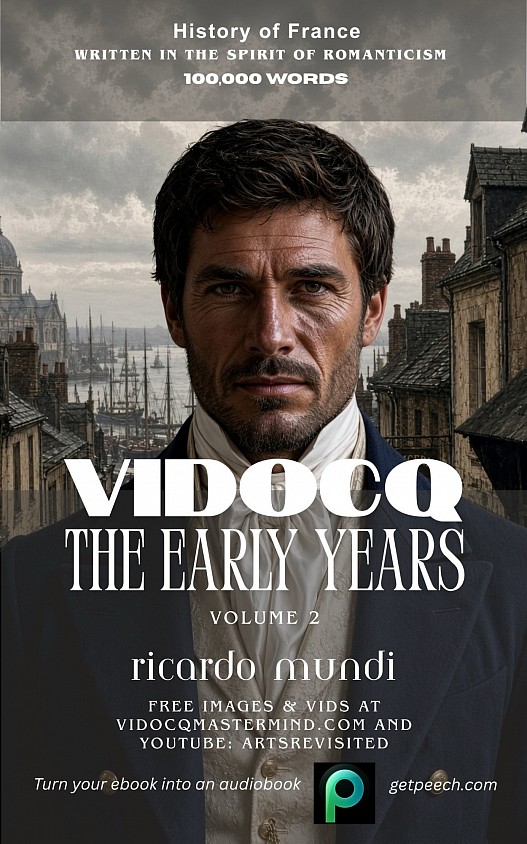
The Early Years Volume 2
The Eternal Observer does not blink when a baker’s son in Arras learns that a lock is only an opinion. Eugène-François Vidocq is born into the smell of yeast and iron in 1775, under a sky that already knows the blade. The shop door slams. The father’s fist is a calendar. The boy answers with forged papers, stolen uniforms, and a talent for vanishing that would shame a ghost. Prisons become rooms he briefly rents. Brest, Toulon, Bicêtre—each wall is a sentence he edits with a file, a rope, a borrowed face. France is tearing itself apart; he treats the tear as a doorway. By the time the Directory grows tired of its own blood, Vidocq has already died several official deaths and walked out of them in other men’s coats. Then the miracle no one expected: the thief offers the state his memory. He founds the Sûreté with twelve men who once shared his chains. He invents the card index, the plaster cast of a boot, the quiet interrogation that begins with a shared cigarette. Paris learns that crime now has a shadow that knows its streets better than the criminals do. He is mastermind twice over—first of the underworld that raised him, then of the machine that hunts it. Disguise is not costume; it is theology. He becomes the beggar, the clerk, the old woman selling apples, and the city confesses to him without knowing it has spoken. Victor Hugo will later split him into two men—one who steals bread, one who never forgets a face—but the living Vidocq contains both without apology. This book does not ask whether a criminal can become the law. It watches the moment the law discovers it needs the criminal’s eyes. The ovens of Arras are cold. The files in the Prefecture are warm. Between them walks a man who has already escaped every ending written for him, and who now writes the endings of others.