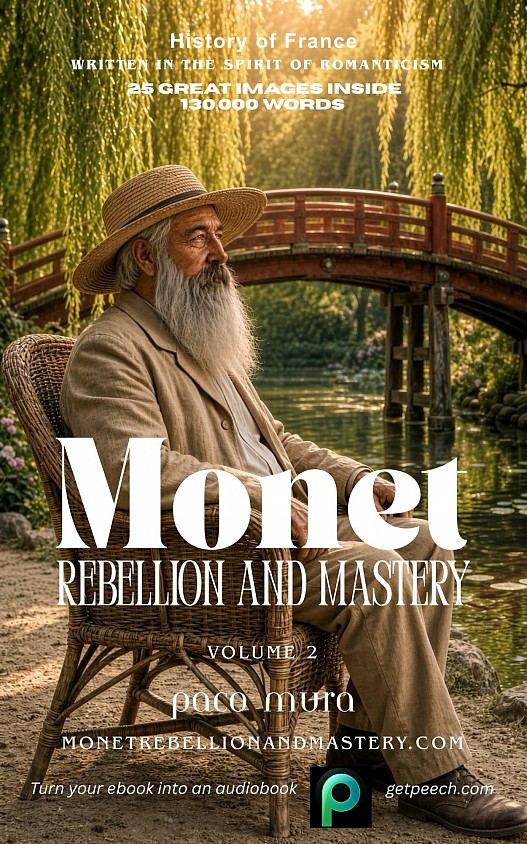
Monet
Rebellion and Mastery Volume 1

Light first claimed Oscar-Claude Monet not in a salon but on the wind-scoured quays of Le Havre, where the Seine meets the Channel and the sky never holds still. Volume I of Monet, Rebellion and Mastery opens in that collision of water and weather. Born in Paris in 1840, the boy was carried at five to the Norman coast. There his earliest fame arrived not through landscapes but through charcoal: swift, merciless caricatures of local worthies that sold for a few francs and already announced an eye that refused to flatter. The turning came with Eugène Boudin. The older painter led the teenager out of the studio and onto the beaches, teaching him that the true subject was not the figure but the trembling envelope of air around it. Sunlight on wet sand, the shifting gray-green of the estuary, the sudden flare of a sail—these became the only academy Monet would ever trust. By 1859 he had abandoned caricature and gone to Paris, already marked as a man who would paint what the moment actually looked like rather than what convention demanded it should. Book II follows that refusal into its first public cost. In Charles Gleyre’s studio Monet found his brothers-in-arms—Renoir, Bazille, Sisley—young men equally impatient with the polished historical machines of the Académie des Beaux-Arts. Together they walked out of the classroom and into the fields and riverbanks, laying down paint in visible, hurried strokes that recorded not eternity but the hour. Poverty shadowed every canvas. Camille Doncieux, his model and companion, bore him a son; they married in 1870 even as war closed around them. Monet fled the Prussian advance to London, returning to settle at Argenteuil on the Seine, where the river itself became both subject and laboratory. There the mature method crystallized: color broken into flickering notes, atmosphere treated as the true protagonist, the fleeting condition of light seized before it vanished. This volume traces the years in which a provincial caricaturist became the most radical landscape painter of his generation—the years when rebellion and mastery were still the same unfinished act.
Rebellion ans Mastery Volume 2
An accidental title, flung in mockery, became the banner under which Monet completed his long war with official taste. Volume 2 of Monet, Rebellion and Mastery now turns to the years when that war left the studios and entered the public square. After years of Salon refusals, Monet and his companions staged their own exhibition in 1874. Among the works hung Impression, Sunrise, a 1872 view of Le Havre’s harbor reduced to trembling orange and violet veils. Critic Louis Leroy seized the word “impression” as a jest; the painters claimed it as doctrine. The name Impressionist was born in ridicule and worn thereafter as armor. Money remained scarce. Camille, already worn by illness and hardship, died in 1879 at thirty-two. Monet sat beside her and painted the last changes of color in her face, an act of devotion and record at once. Soon afterward he joined Alice Hoschedé and her children, merging two broken households first at Poissy, then, in 1883, in the quiet village of Giverny forty miles from Paris. There the second half of the volume unfolds. Monet rented, then bought, the pink house and its grounds. He spent the remaining decades reshaping earth and water into a living canvas: a Japanese bridge, weeping willows, and a pond dense with water lilies. Giverny ceased to be merely a home; it became the sole subject. He painted the same motifs—grainstacks, poplars, the west front of Rouen Cathedral, the lily pond itself—across hours, seasons, and weather, treating time as a series of fugitive states rather than a single fixed view. Even after cataracts clouded his sight in his eighties, he continued, producing the vast Grandes Décorations, mural-scale immersions in the pond’s surface. He died at Giverny on 5 December 1926, eighty-six years old, leaving a body of work that had already begun to dissolve representation into pure sensation and thereby opened the road toward abstraction.
These pages follow the painter from the first independent hanging to the last trembling stroke beside his own water.